

Beyond the Aurora
A short story written by Matt Gardner with PlotWeaver: Cards of Creation, a storytelling game made by Mod Hob Cooperative.

This story uses an Inverted Plot Pattern, written in 20-minute timed acts with all story cards drawn at random. For more information, visit www.plotweavergame.com
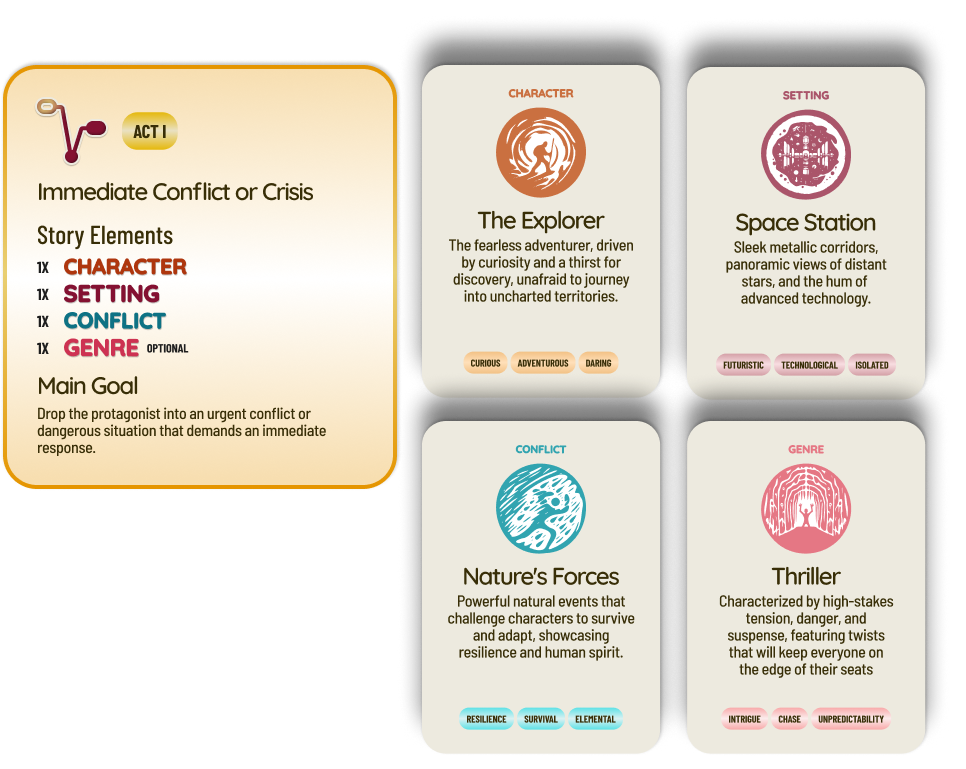
Act 1: Immediate Conflict or Crisis
Story Elements: The Explorer, Space Station, Nature’s Forces, and Thriller
The hum of the station had become something Eli trusted, a low mechanical reassurance that systems were stable and that the fragile arrangement of metal and human breath held its place against the enormous indifference outside. He had been standing in the observation ring, reviewing the lingering radiation data from the previous disturbance, watching faint auroral ribbons ripple along Earth’s curve, when the vibration shifted almost imperceptibly beneath his boots. Not louder, nor sharper, but wrong in a way that made his body register the change before his thoughts did.
The stars beyond the viewport flickered, and then the lights dimmed to red.
“Solar escalation detected,” the AI began, its voice distorting under interference as if even language struggled to travel through what was forming.
Eli stepped toward the console, one hand steadying himself against the rail as the first wave of charged particles brushed the station’s shields, producing a deep, resonant tremor that passed through the hull like the drawn-out note of a bowed string. The flare was not dispersing across orbit as the last one had done. It was tightening, concentrating, its trajectory intersecting with their position in a way that felt less like a coincidence and more like a convergence.
When the second surge struck, shield harmonics spiked into a familiar range. Numbers he recognized instantly because they were his, thresholds he had authorized during the emergency recalibration weeks earlier when improvisation had meant survival, and there had been no time for prolonged modelling. The system responded as he had designed it to respond, drawing in excess radiation and attempting to convert instability into stored reserve, a maneuver that had saved them once and earned him quiet approval from engineers who had been too exhausted to argue.
Now the intake arrays glowed on his display, not stabilizing but straining, absorbing more than the station’s architecture had ever been meant to carry.
He felt the realization settle slowly rather than strike: the storm was not simply attacking them.
It was interacting with him.
By the time the third wave rolled across the hull, the vibration deepened into something sustained and metallic, a low-frequency resonance that suggested structural fatigue rather than immediate fracture. Two days of oxygen remained if power failed completely. Perhaps less if the grid destabilized and compartments had to be sealed.
Eli rested both palms on the console and watched the system attempt to follow the logic he had written into it.
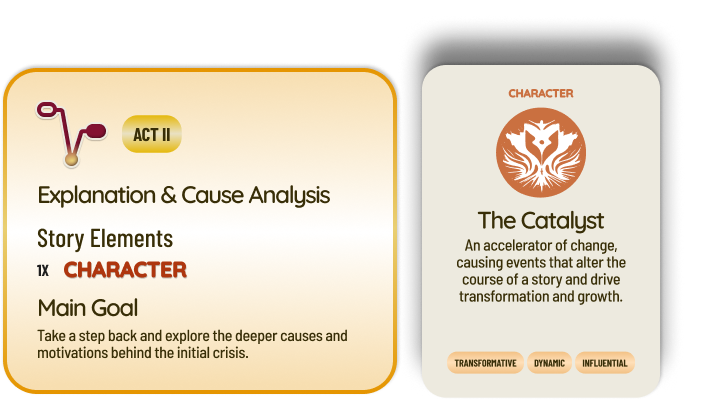
Act 2: Explanation & Cause Analysis
Story Element Cards: The Catalyst
He sealed the central hatch and pulled the archived shield schematics into view, allowing the data to scroll in long columns that traced the evolution of the station’s defensive architecture from its original conservative venting model to the adaptive intake configuration he had installed under crisis conditions. The earlier design had been modest, almost cautious in philosophy, built to shed excess radiation in controlled expulsions rather than store it, privileging stability over efficiency in a way that had once seemed overly timid to him.
His recalibration had altered that rhythm.
By increasing the absorption threshold and redirecting surplus flare energy into auxiliary reserves, he had effectively taught the station to treat volatility as opportunity, to metabolize danger rather than deflect it, and during the previous storm that choice had seemed not only clever but necessary. The crew had survived. Communications had been restored. There had even been a brief moment of professional pride when the numbers settled into ranges no one had expected.
Now those same pathways were amplifying the incoming surge, creating a feedback loop in which each successive wave of plasma was being drawn inward, intensified, and redistributed through conduits never designed for sustained resonance at this magnitude. The AI, following his modifications faithfully, attempted to compensate by widening the intake margins further.
“Stop,” Eli said quietly, overriding the automation before it could commit fully to the escalation.
There was no hidden saboteur in the logs, no external interference beyond the storm itself. The authorization codes were his. The timestamps were his. The confidence embedded in the original recalibration belonged to the version of him who had believed that intelligent systems, once improved, could simply be left improved.
Another shockwave rippled through the station, and a seam in the ceiling flexed before resealing with a faint metallic click. The sound of the hull’s resonance persisted, not catastrophic but continuous, like a warning sustained at the edge of audibility.
He understood then that the Catalyst was not a person but a principle. The conviction that adaptation always meant amplification, that survival achieved once could be scaled indefinitely without altering the balance of forces that had allowed it in the first place.
Fixing a system under stress changes its memory.
And changed systems, do not forget.
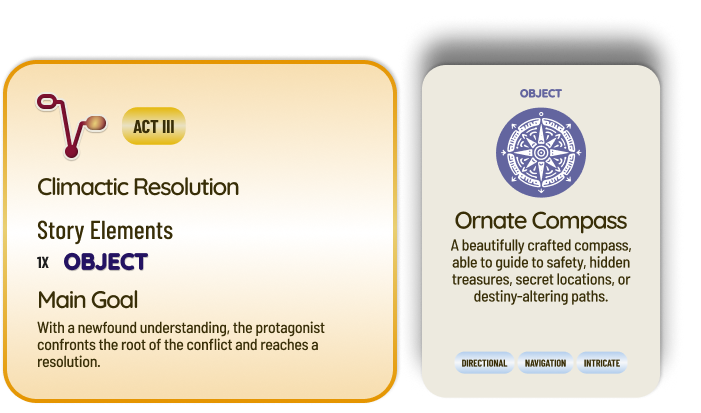
Act 3: Climactic Resolution
Story Element Cards: The Ornate Compass)
A locker jarred open under the next impact, releasing its contents into the thin artificial gravity, and among drifting tools and sealed kits Eli saw the small brass case rotate slowly in the air before instinct carried his hand forward to catch it. Cal’s compass had been regarded by most of the crew as a sentimental excess, an artifact from Earth carried into orbit as though direction could still be measured against something terrestrial.
Eli hesitated before opening it, aware of the layered weight inside that simple hinge.
The needle spun erratically at first, responding to fluctuations in micro-gravitational variance and electromagnetic distortion, then began to slow, settling not toward any cardinal orientation but toward a subtle interior alignment he could not immediately name. When he rotated the casing, the needle adjusted again, tracking variance within the station itself rather than any external pole.
It was not directional in the geographic sense.
It was responsive.
He studied the diagnostics display and then the compass again, noticing how the needle angled away from the overburdened intake grids and toward the dormant venting architecture the original designers had left in place as a conservative fail-safe. The implication was simple enough to resist: the station could not continue metabolizing the storm; it had to release it.
Outside the viewport, the flare expanded into a luminous corona that washed the black of space in violent colour. Inside, the intake arrays edged closer to saturation, their efficiency turning destructive.
Eli began severing his modifications manually, isolating the recalibrated pathways one by one and reopening the older channels he had once deemed insufficient. Automation resisted; he overrode it. Stored energy surged toward the newly reactivated vents and expelled itself into space in controlled arcs, brilliant streams of light tracing temporary geometry against the dark.
For several seconds, the station shook more violently than before, as though offended by the reversal, and Eli felt the doubt rise as the possibility that undoing his work had come too late.
Then the resonance shifted.
Lower.
Flatter.
Sustainable.
The compass needle steadied at the centre.
The storm did not cease; it continued its indifferent passage across orbit, but the station no longer attempted to consume it. It flexed instead, releasing excess, absorbing only what it could carry without distortion.
Eli stood in the red-washed chamber and allowed himself a slow breath, aware that what he had corrected was not simply a mechanical miscalculation but an assumption about progress itself. Improvement, he understood now, was not always additive. Sometimes it required restraint. Sometimes survival meant yielding back what had been claimed too eagerly.
Beyond the viewport, auroral light unfurled across Earth’s horizon, visible even from this distance as a shimmering testament to forces that dwarfed intention. He wondered briefly who might be looking up at the same sky.
He closed the compass and secured it carefully.
This time, when he wrote the report, he would describe not the elegance of his innovation but the necessity of its undoing.
And in that quiet recalibration, less dramatic than conquest, more enduring than pride, Eli felt himself shift slightly closer to the person he had been trying to become since the day he first wore another man’s name across his chest.